Finasteride (Propecia)
Finasteride is an oral prescription medication that represents one of the most effective non-surgical treatments for male pattern hair loss (androgenetic alopecia). As a selective type II 5-alpha reductase inhibitor, it works by reducing the conversion of testosterone to dihydrotestosterone (DHT) — the primary hormone responsible for miniaturizing hair follicles in genetically susceptible individuals.
First approved by the FDA in 1992 at the 5mg dose for treating benign prostatic hyperplasia (BPH) under the brand name Proscar, finasteride was later approved in 1997 at the lower 1mg dose specifically for male pattern hair loss under the brand Propecia. It has since become one of the most prescribed medications for hair loss worldwide.
Clinical data spanning over two decades demonstrates that approximately 90% of men taking finasteride will either maintain their existing hair or experience regrowth. The medication is most effective when started early in the hair loss process and must be taken continuously to maintain benefits, as hair loss typically resumes within 12 months of discontinuation.

Dr. Igor I. Bussel, MD
Board-Certified Ophthalmologist, Medical Reviewer
Dr. Igor I. Bussel is a board-certified ophthalmologist and fellowship-trained surgeon affiliated with the University of California, Irvine (UCI), the Gavin Herbert Eye Institute, and the UCI School of Medicine.
Last Updated: February 2026
⚙ Mechanism of Action
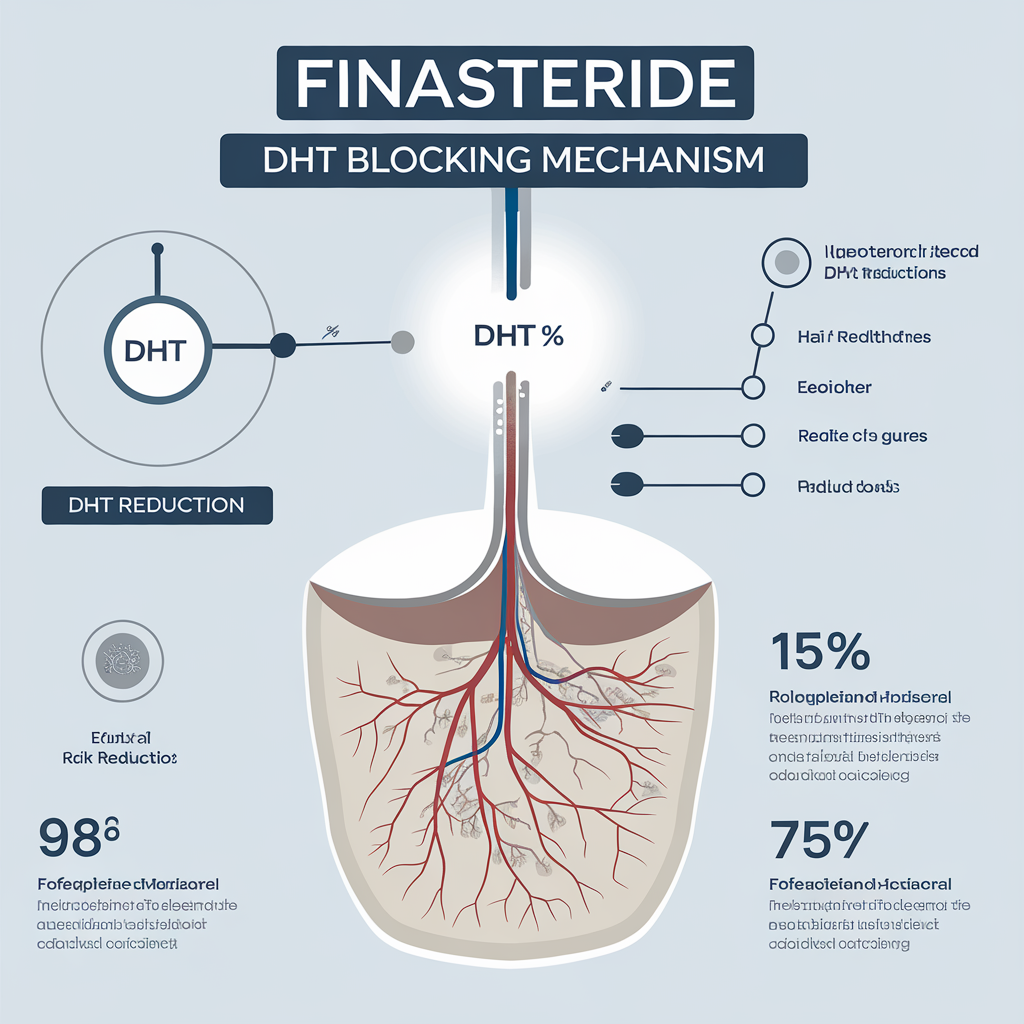
Finasteride inhibits type 2 5-alpha reductase, reducing DHT levels by approximately 71% in the scalp. DHT is the hormone responsible for androgenetic alopecia in genetically susceptible individuals.
📖 In-Depth Overview
The story of finasteride begins with a genetic discovery. In the 1970s, researcher Julianne Imperato-McGinley studied a group of males in the Dominican Republic who were born with ambiguous genitalia due to a deficiency of the enzyme 5-alpha reductase. These individuals never developed male pattern baldness or prostate enlargement — a crucial observation that directly linked DHT to both conditions.
This discovery prompted Merck to develop finasteride, a synthetic compound that selectively inhibits type II 5-alpha reductase. By blocking this enzyme, finasteride reduces serum DHT levels by approximately 71% and scalp DHT levels by about 64%, without significantly affecting testosterone levels. This targeted approach preserves most androgenic functions while specifically protecting vulnerable hair follicles.
The drug works by halting the miniaturization process that characterizes androgenetic alopecia. In genetically susceptible follicles, DHT causes a progressive shortening of the anagen phase and shrinkage of the follicle, eventually producing only fine, vellus hairs. By reducing DHT exposure, finasteride allows these follicles to recover and produce thicker, terminal hairs again.
Finasteride is best suited for men with mild to moderate androgenetic alopecia, particularly those in Norwood stages II through V. It is most effective for vertex (crown) hair loss but also shows benefits for frontal and mid-scalp thinning. The medication is generally not recommended for women of childbearing age due to teratogenic risks, though some dermatologists prescribe it off-label for post-menopausal women. Response rates are highest in younger men who begin treatment early in the hair loss process.
📊 Effectiveness Data
🔬 Clinical Studies
Kaufman et al. - 5-Year Finasteride Efficacy Trial
1998At 2 years, 83% of men on finasteride maintained or increased hair count vs. 28% on placebo. At 5 years, 90% of finasteride-treated men showed visible improvement or no further loss compared to baseline.
Rossi et al. - 10-Year Long-Term Finasteride Study
2011Long-term finasteride use over 10 years maintained hair growth improvements in 86% of patients. Only 14% experienced worsening despite continuous treatment. Drug-related adverse events occurred in less than 2% of patients.
Yanagisawa et al. - Finasteride in Asian Men
2019After 5 years of 1mg finasteride treatment, 99.1% of Japanese men showed improvement or stabilization. Hair density significantly increased from baseline with sustained benefits.
✓ Who Is It For
Finasteride is ideal for adult men (18+) with early to moderate male pattern hair loss (Norwood II-V), particularly those with vertex and mid-scalp thinning. It works best when started early — men who begin treatment when they first notice thinning tend to get the best long-term outcomes. It's perfect for men seeking a convenient once-daily pill rather than topical treatments, and for those who want to address the hormonal root cause of their hair loss.
✗ Who Should Avoid
Women who are pregnant or may become pregnant must not handle crushed or broken finasteride tablets, as the drug can cause birth defects in male fetuses. Men with liver disease should use caution, as finasteride is metabolized hepatically. Those with a history of depression or mood disorders should discuss risks with their doctor, as there are reported associations. Men planning to conceive should be aware of potential effects on sperm parameters, though these are generally reversible. Anyone with concerns about sexual side effects should have an open discussion with their prescribing physician.
💰 Cost Breakdown
⚖ How It Compares
Finasteride is generally considered more effective than minoxidil for frontal hair loss and overall hair maintenance, while minoxidil may have an edge for crown regrowth. Dutasteride blocks DHT more completely (98% vs. 71%) and shows superior efficacy in comparative studies, but has a longer half-life and potentially more side effects. Compared to PRP or LLLT, finasteride has much stronger long-term clinical evidence and is significantly less expensive. The most effective approach typically combines finasteride with minoxidil, leveraging both DHT reduction and growth stimulation simultaneously.
💡 Expert Tips from Dermatologists
Take finasteride at the same time each day to maintain consistent blood levels — morning or night doesn't matter, but consistency does.
Give it at least 12 months before judging effectiveness. Hair growth cycles are slow, and premature discontinuation is the #1 reason for perceived failure.
If you experience side effects, discuss lowering the dose to 0.5mg or switching to every-other-day dosing with your doctor — many patients tolerate reduced doses well.
Don't split Proscar 5mg tablets as a cost-saving measure without consulting your doctor, as uneven splitting leads to inconsistent dosing.
Combine with minoxidil 5% for maximum synergistic effect — studies show the combination outperforms either agent alone.
Get a baseline PSA test before starting, as finasteride lowers PSA levels by approximately 50%, which can mask prostate cancer screening.
🔗 Combination Protocols
Commonly combined with minoxidil for enhanced effect