Stem Cell Therapy
Stem cell therapy for hair loss represents one of the most ambitious approaches in regenerative medicine, aiming to use the body's own regenerative cells to repair, regenerate, or replace damaged hair follicles. The therapy uses mesenchymal stem cells (MSCs) or hair follicle stem cells to create a microenvironment that supports new hair growth and follicle regeneration.
While the scientific foundation is compelling — stem cells have demonstrated the ability to differentiate into various cell types, including those found in hair follicles — the therapy remains firmly in the experimental phase. It is NOT FDA-approved for hair loss, and most treatments available today are offered through clinical trials or experimental protocols at specialized centers.
The concept holds enormous long-term potential: if scientists can reliably induce stem cells to generate new hair follicles, it would fundamentally change hair restoration by providing an unlimited supply of transplantable follicles. Several approaches are being investigated, including adipose-derived stem cell injections, bone marrow-derived stem cell therapy, and follicular stem cell isolation and expansion.
Dr. Igor I. Bussel, MD
Board-Certified Ophthalmologist, Medical Reviewer
Dr. Igor I. Bussel is a board-certified ophthalmologist and fellowship-trained surgeon affiliated with the University of California, Irvine (UCI), the Gavin Herbert Eye Institute, and the UCI School of Medicine.
Last Updated: February 2026

⚙ Mechanism of Action
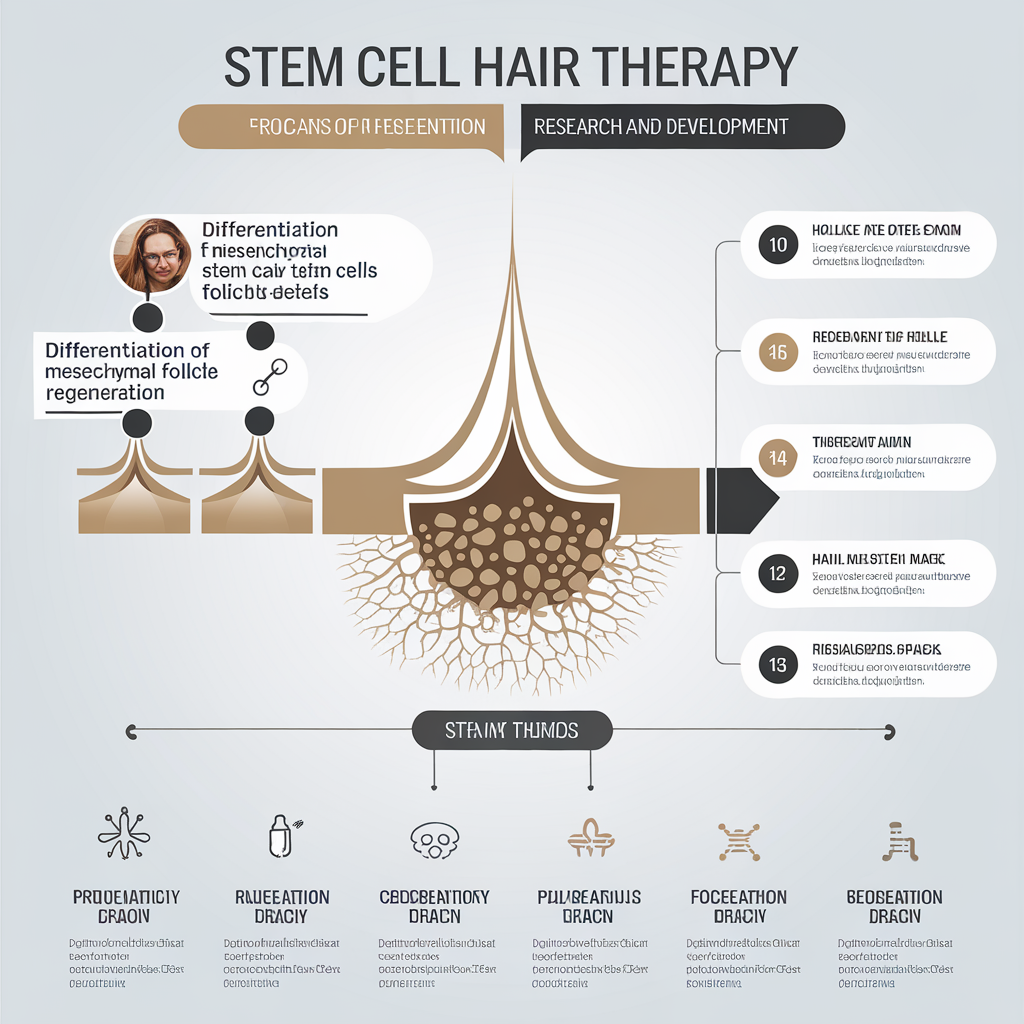
Mesenchymal stem cells differentiate into hair follicle cells or secrete growth factors that stimulate follicle regeneration
📖 In-Depth Overview
Research into stem cells and hair follicles dates back to the 1990s, when scientists began to understand the role of stem cells in the hair follicle bulge — a reservoir of multipotent stem cells that drives hair cycling throughout life. The idea that these stem cells could be harnessed for therapeutic purposes has driven decades of research.
There are several distinct approaches to stem cell therapy for hair loss, each at different stages of development. Adipose-derived stem cell therapy involves harvesting fat tissue (usually via liposuction), processing it to isolate the stromal vascular fraction (SVF) containing stem cells, and injecting it into the scalp. This approach is the most commercially available, though evidence is limited.
Bone marrow-derived stem cell therapy follows a similar concept but uses bone marrow aspirate concentrate (BMAC) as the stem cell source. This approach has shown some promise in small studies but involves a more invasive harvesting procedure.
The most scientifically ambitious approach involves isolating hair follicle stem cells, expanding them in culture, and implanting them to generate new follicles. This is essentially the same concept as hair cloning (discussed separately) and faces significant technical challenges in maintaining the hair-inductive properties of cells during culture expansion.
Conditioned media therapy represents a middle-ground approach: stem cells are cultured in the laboratory, and the growth factor-rich media they produce is harvested and injected into the scalp. This provides stem cell-derived benefits without injecting the cells themselves.
Multiple clinical trials are ongoing (including NCT06764329 and NCT02865421), and the field is advancing rapidly. However, patients should understand that commercially available 'stem cell therapy' for hair loss today is largely unregulated, with wide variation in protocols, cell sources, and claimed outcomes.
🔬 Clinical Studies
Fukuoka & Suga - Adipose-Derived SVF for Alopecia
2015Injection of adipose-derived stromal vascular fraction (SVF) resulted in increased hair density of approximately 29% and hair diameter increase of 14% at 6 months post-treatment in patients with androgenetic alopecia.
Gentile et al. - Autologous Micrografts for AGA
2019Hair follicle micrografts containing progenitor cells showed 28.4% increase in hair density at 6 months compared to a 2.1% increase in placebo-treated areas. Results were maintained at 12-month follow-up.
Elmaadawi et al. - Bone Marrow Stem Cells for Alopecia Areata
2018Injection of autologous bone marrow-derived mononuclear cells resulted in significant hair regrowth in 60% of patients with alopecia areata resistant to conventional therapy. Improvement was maintained for 6+ months.
✓ Who Is It For
Stem cell therapy is currently most appropriate for patients enrolled in legitimate clinical trials or those treated at reputable academic medical centers conducting research protocols. It may be considered by patients who have exhausted all conventional treatments without success and are willing to accept the uncertainty and cost of experimental therapy. Those with severe, treatment-resistant alopecia areata may be candidates for bone marrow-derived approaches in trial settings.
✗ Who Should Avoid
Most patients should currently avoid commercial stem cell therapy marketed for hair loss, as the evidence is insufficient to justify the high cost and uncertain outcomes. Patients with active cancers or a history of cancer should avoid stem cell therapies due to theoretical (though unproven) concerns about cell proliferation. Those who are not comfortable with experimental treatments, cannot afford the high cost ($5,000-$20,000+), or have unrealistic expectations about outcomes should wait for more established evidence. Pregnant and breastfeeding women should avoid all stem cell procedures.
💰 Cost Breakdown
⚖ How It Compares
Stem cell therapy is the most experimental and least proven option in the hair loss treatment arsenal. Compared to PRP, it is more expensive, less studied, and less widely available. Compared to medications (finasteride, minoxidil), it lacks the decades of safety and efficacy data that support those treatments. Compared to hair transplant surgery, stem cell therapy cannot yet reliably generate new follicles for transplantation. Its primary advantage is theoretical: if perfected, it could offer unlimited hair follicle regeneration. Until that potential is realized, proven treatments remain the foundation of effective hair loss management.
💡 Expert Tips from Dermatologists
If considering stem cell therapy, seek treatment at academic medical centers or through registered clinical trials (search clinicaltrials.gov) rather than commercial clinics.
Be skeptical of commercial clinics advertising 'stem cell therapy' — many offer variations of PRP or SVF that may not contain significant stem cell populations.
Ask providers for published, peer-reviewed evidence supporting their specific protocol — not just general stem cell research.
Don't abandon proven treatments in favor of experimental stem cell therapy — continue finasteride, minoxidil, and other evidence-based treatments.
Understand that most 'results' shown by commercial stem cell clinics are anecdotal and may not be reproducible.
The field is advancing rapidly — what's experimental today may be mainstream in 5-10 years. Consider following research developments while using proven treatments.